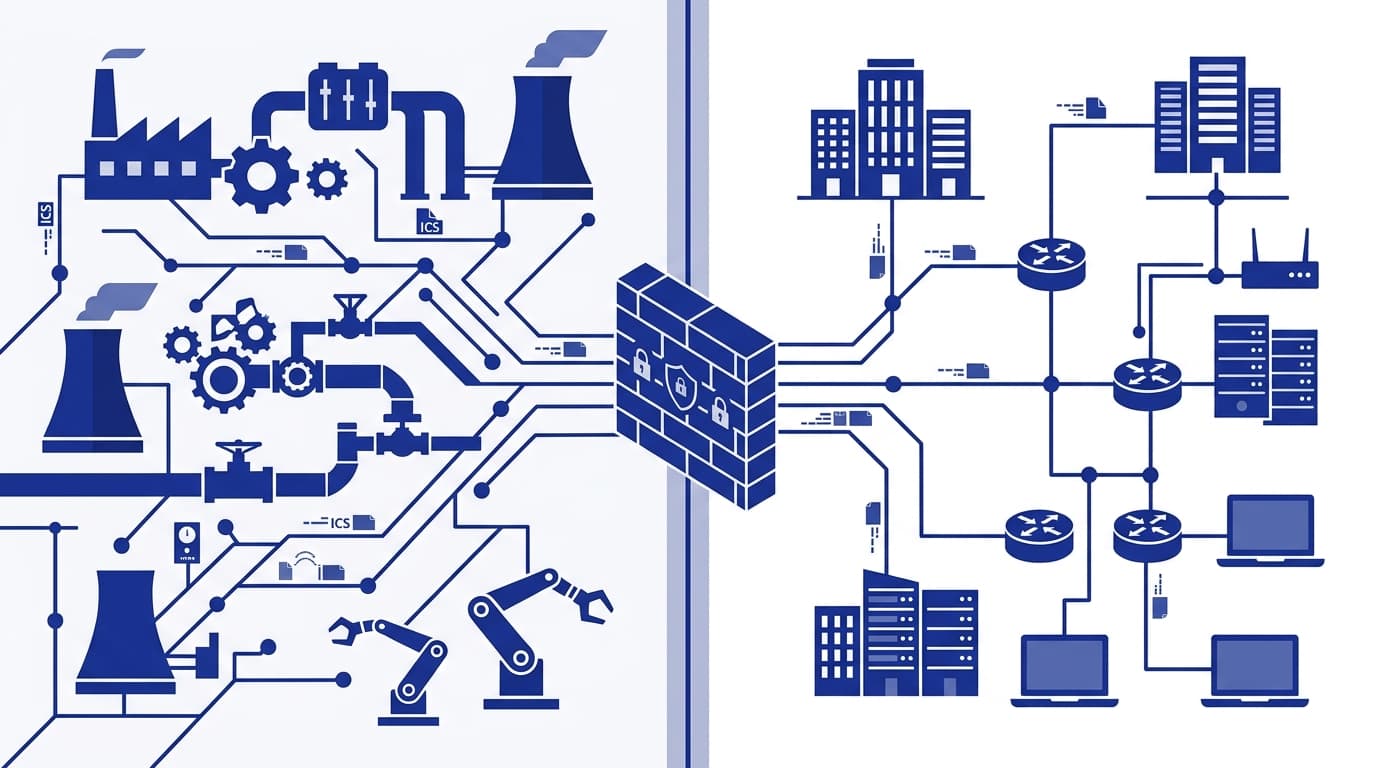
The convergence of Information Technology (IT) and Operational Technology (OT) has brought unprecedented visibility and efficiency to modern industrial environments. However, applying IT security paradigms directly to OT environments is a recipe for operational disruption. While IT prioritizes data confidentiality, OT is governed by a fundamentally different set of imperatives. Understanding these differences is the foundation of effective industrial cybersecurity.
The Priority Inversion: Safety and Availability First
In traditional IT environments, the universally accepted model is the CIA triad: Confidentiality, Integrity, and Availability. If a data breach is suspected, the standard IT response is to isolate the system, potentially taking it offline to preserve data confidentiality.
In OT, this model is inverted to AIC: Availability, Integrity, and Confidentiality. Or, more accurately, Safety, Reliability, and Availability.
If a safety instrumented system (SIS) detects an anomaly, the goal is to keep the process running safely or bring it to a safe halt. Taking a Programmable Logic Controller (PLC) or Distributed Control System (DCS) offline to investigate a potential cyber threat could cause a catastrophic physical event, environmental damage, or a multi-million-dollar production halt. In OT, physical safety always trumps data secrecy.
Lifecycles: 3 Years vs. 30 Years
IT assets are typically refreshed every three to five years. Operating systems are constantly updated, and legacy hardware is retired quickly.
OT environments are characterized by extreme longevity. A PLC installed on a manufacturing line or in a substation might remain in continuous operation for 20 to 30 years. These legacy systems were designed in an era before industrial network security was a concern. They often lack basic authentication mechanisms, rely on clear-text protocols (like Modbus TCP or DNP3), and run on outdated, unsupported operating systems (like Windows XP or even older embedded systems).
You cannot simply upgrade these systems without a massive capital expenditure (CAPEX) project, meaning security controls must be designed to protect vulnerable legacy assets rather than replacing them.
The Patching Paradox
In IT, automated "Patch Tuesday" rollouts are a standard practice to mitigate vulnerabilities. In OT, patching is an intricate, high-risk operation.
You cannot arbitrarily reboot a running PLC controlling a continuous chemical process or a power generation turbine. Patching in OT requires:
- Vendor certification (applying an uncertified patch can void warranties and support agreements).
- Extensive testing in an offline staging environment to ensure the patch doesn't alter real-time processing behavior.
- Waiting for a scheduled maintenance window or plant turnaround, which may only happen once a year.
As a result, OT systems are inherently unpatched and vulnerable. Industrial cybersecurity must therefore rely on compensating controls—like network segmentation and anomaly detection—to protect these unpatchable assets.
Real-Time Determinism
IT networks are designed for throughput and can tolerate latency. If an email takes two seconds longer to deliver, no one notices.
OT networks require determinism. Control loops operate in milliseconds. If a sensor reading from a critical valve is delayed due to network congestion caused by a poorly configured vulnerability scanner or an active IT-style antivirus scan, the controller might miss a critical setpoint, leading to a physical failure. Security tools deployed in OT must be strictly passive or specifically designed for deterministic industrial environments.
The Relevance of the Purdue Model
To manage these differences, the industry relies on the Purdue Enterprise Reference Architecture (PERA), commonly known as the Purdue Model. The Purdue Model provides a structural hierarchy for segmenting IT and OT networks:
- Level 5/4 (Enterprise IT): Corporate networks, email, ERP systems.
- Level 3.5 (Industrial DMZ): The critical buffer zone between IT and OT.
- Level 3 (Site Operations): Plant-wide historians, manufacturing execution systems (MES), patch management servers.
- Level 2 (Area Supervisory Control): Human-Machine Interfaces (HMIs), supervisory SCADA servers.
- Level 1 (Basic Control): PLCs, RTUs, intelligent electronic devices (IEDs).
- Level 0 (Physical Process): Sensors, actuators, motors, valves.
Traditional IT security focuses heavily on Levels 4 and 5. Effective OT security must protect Levels 0 through 3, recognizing that the lower the level, the more critical the availability and real-time requirements become.
IT/OT Convergence Challenges
The push for Industry 4.0 and digital transformation means that previously isolated OT networks are now increasingly connected to the enterprise IT network and the cloud. This convergence breaks down the traditional "air gap" (which was largely a myth anyway due to USB drives and vendor laptops).
This connectivity introduces IT-centric threats—like ransomware—into the OT space. We have seen numerous incidents where ransomware infections on the IT network forced organizations to proactively shut down their OT environments out of an abundance of caution, halting production for days or weeks.
Key Takeaways
- Acknowledge the Differences: Do not force IT security policies onto OT environments. A tailored approach is required.
- Prioritize Availability: Ensure all security tools and procedures respect the real-time, deterministic nature of industrial control systems.
- Use Compensating Controls: Accept that OT assets will remain vulnerable and unpatched for long periods. Implement robust network segmentation, industrial deep packet inspection, and strict access controls to compensate.
- Bridge the Cultural Divide: Foster collaboration between IT security teams and plant engineers. IT brings cybersecurity expertise, while OT engineers understand the physical processes that must be protected.