
Article
What an OT Security Health Check Actually Finds
Look behind the curtain of a typical OT security assessment. Discover the most common vulnerabilities hidden in industrial environments and why finding them matters.
Mar 25, 20245 min read
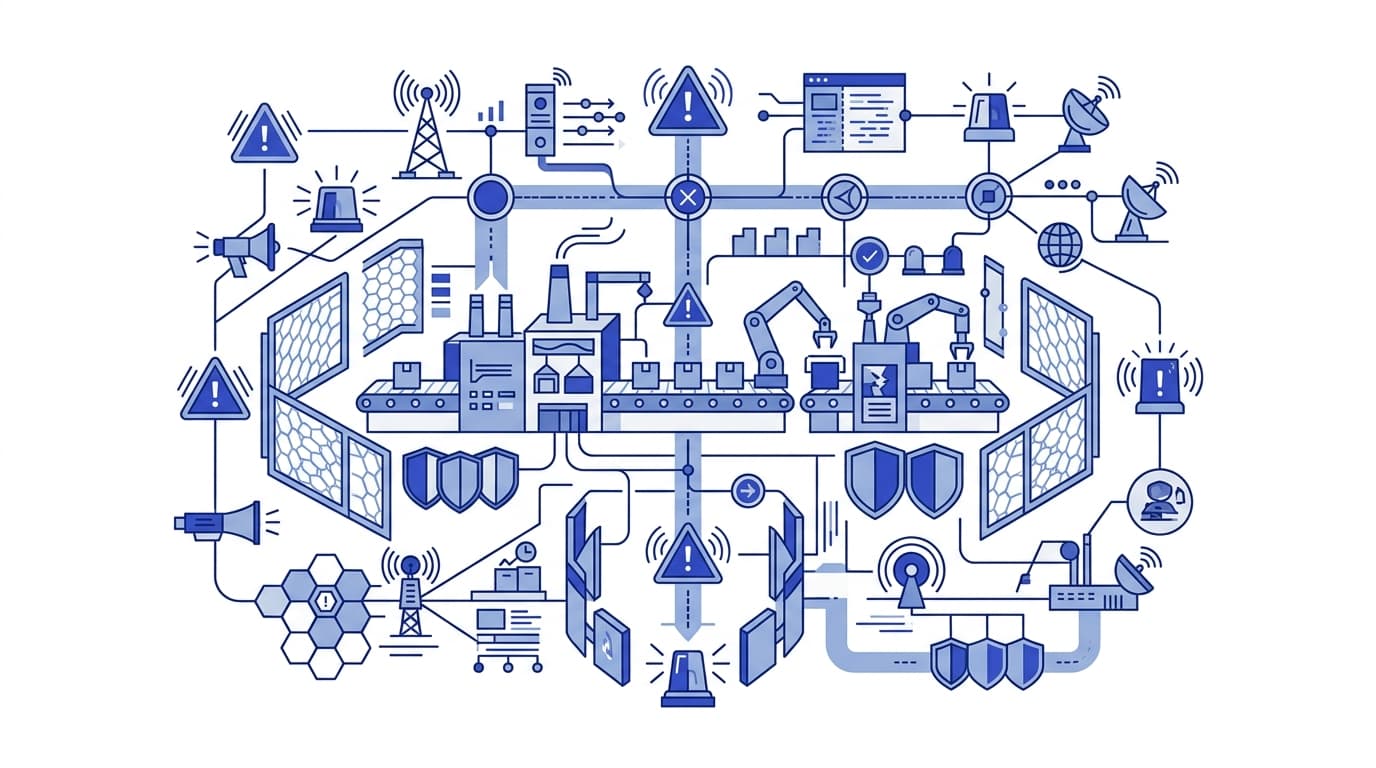
When a cyberattack hits an organization, the difference between a minor disruption and a catastrophic, multi-million-dollar outage lies entirely in the effectiveness of the Incident Response (IR) plan.
However, one of the most critical mistakes manufacturing organizations make is assuming their corporate IT incident response plan can be seamlessly applied to the plant floor. Responding to an incident in an Operational Technology (OT) environment requires a fundamentally different mindset, specialized tools, and a distinct set of priorities.
In the IT world, the priority during a security breach is usually Confidentiality. If a database server containing customer records is compromised, the standard IT response is to immediately disconnect it from the network to stop data exfiltration.
In the OT world, the absolute priorities are Safety and Availability. If a Human-Machine Interface (HMI) or a Programmable Logic Controller (PLC) controlling a continuous chemical process, a high-speed packaging line, or a blast furnace is compromised, you cannot simply "pull the plug." Abruptly shutting down an industrial process without following standard safety shutdown procedures can result in physical destruction of equipment, environmental hazards, and severe danger to human life.
An IT engineer cannot unilaterally decide to quarantine a device on the plant floor. OT incident response requires tight coordination between cybersecurity experts and the plant engineers who understand the physical physics of the process.
To build true resilience, manufacturing organizations must develop dedicated OT Incident Response playbooks. These playbooks should incorporate the following critical elements:
An OT IR team must bridge the IT/OT divide. It should include IT security analysts (who understand malware behavior and network forensics) and OT engineers (who understand process control, safety systems, and automation architecture).
Crucially, the IR plan must define Decision Authority. Who has the authority to order the shutdown of a multi-million-dollar production line? It is rarely the IT Security Operations Center (SOC); it is usually the Plant Manager or the Operations Director, acting on intelligence provided by the security team.
Because you cannot just disconnect critical assets, you need nuanced containment strategies. Playbooks must define how to isolate compromised segments without halting the entire plant.
Industrial control systems are often legacy devices with minimal storage and memory. If a PLC is rebooted, the volatile memory—which may contain the malicious code or the command history that caused an anomaly—is permanently lost.
OT IR plans must include specific procedures for capturing network traffic (PCAP) and extracting logs from HMIs and historians before systems are reset or power-cycled.
During an incident, standard IT communication channels (like corporate email or Slack) might be compromised or taken offline. The OT IR plan must establish Out-of-Band (OOB) communication methods, such as dedicated mobile apps, physical radios, or secondary communication networks, to ensure the incident response team can coordinate securely.
Not all systems are equally important. An effective IR plan pre-identifies the "Crown Jewels"—the critical path systems required for minimum viable production and the Safety Instrumented Systems (SIS) required for human safety.
Recovery playbooks must dictate that these systems are restored and verified first. A non-critical data historian or a remote monitoring dashboard can wait; the core process control loops cannot.
An incident response plan is merely a theoretical document until it is tested. The most effective way to build readiness is through OT-specific Tabletop Exercises (TTX).
Gather your IT, security, and plant operations leadership in a room and walk through a simulated, realistic scenario.
Example Scenario: "Ransomware has encrypted the engineering workstations in the Level 3 site operations zone. Operators can still see the process on local HMIs, but the centralized historian is down, and the automated batch recipes cannot be updated. What do you do?"
These exercises inevitably reveal gaps in communication, undefined authorities, and technical dependencies that were previously unknown.
Do not wait for a crisis to discover that your IT IR plan is incompatible with your manufacturing floor. Building an OT-specific IR readiness program—focused on safety, safe containment, cross-functional collaboration, and rigorous tabletop testing—is essential for minimizing downtime and ensuring the resilience of your industrial operations against an inevitable cyber incident.
Look behind the curtain of a typical OT security assessment. Discover the most common vulnerabilities hidden in industrial environments and why finding them matters.
Vendor remote access is a necessity, but it's often the weakest link in OT security. Learn how to secure external access without hindering maintenance.
Discover the hidden risks of flat industrial networks, how they facilitate lateral movement for attackers, and practical steps to begin segmenting your OT environment.