Industrial control systems (ICS) were traditionally designed for continuous operation and reliability, not security. As connectivity increases, the risk of cyber threats moving laterally through an industrial environment has skyrocketed. The most effective defense against this lateral movement is robust network segmentation, and the global standard for achieving this is ISA/IEC 62443.
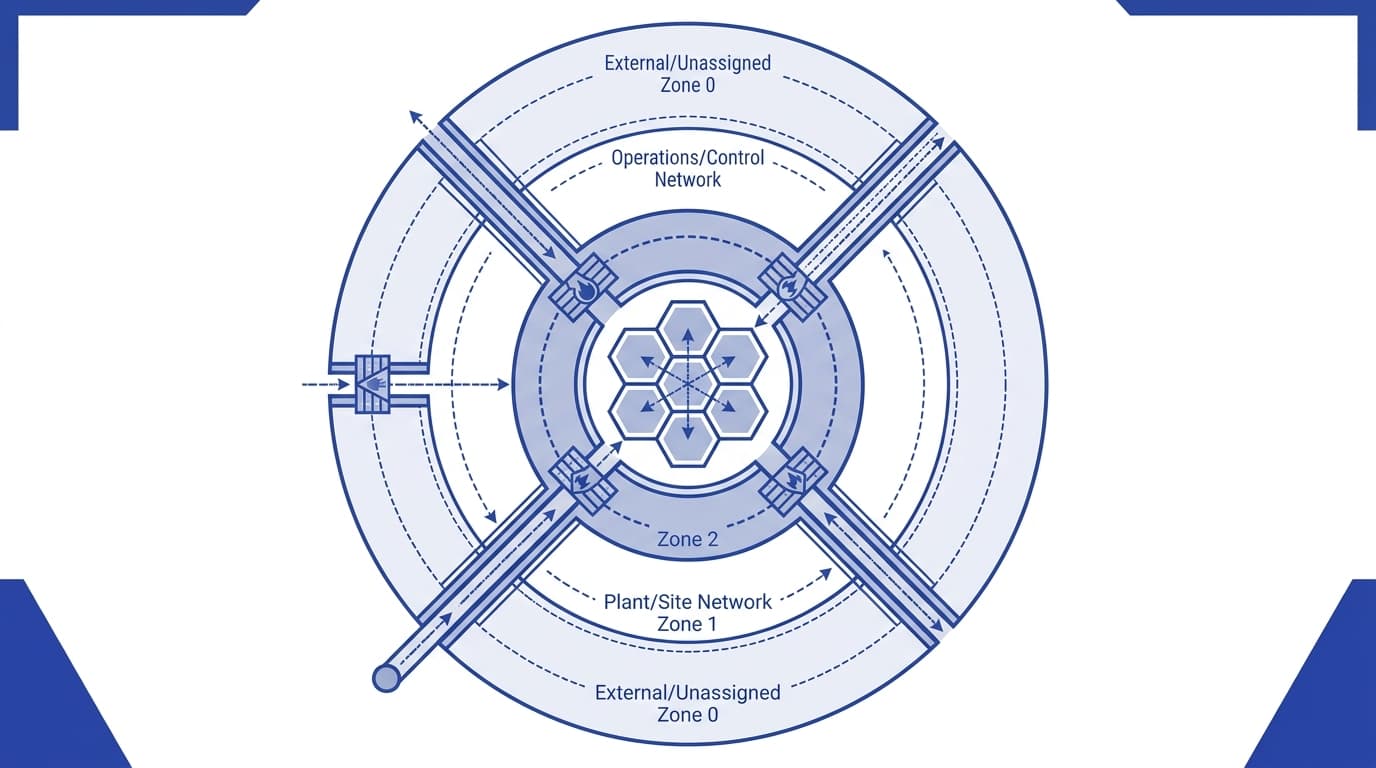
At the core of IEC 62443 is the concept of Zones and Conduits, a methodology for partitioning systems into manageable, secure segments. This guide breaks down these concepts and how to apply them practically.
Understanding Zones
A Zone is a logical grouping of physical or virtual assets that share common security requirements.
Think of a zone as a secure room in a building. Everything inside that room has the same level of trust. When defining zones, you aren't just grouping devices by their physical location or IP subnet; you are grouping them based on their criticality, function, and the potential consequence if they were compromised.
For example, a group of PLCs controlling a hazardous chemical mixing process requires a higher level of protection than the HMIs used by operators to monitor a non-critical water cooling loop. Therefore, they belong in separate zones.
Defining Security Levels (SL)
IEC 62443 defines Security Levels (SL) on a scale from 1 to 4 to quantify the security requirements of a zone:
- SL 1: Protection against casual or coincidental violation.
- SL 2: Protection against intentional violation using simple means with low resources, generic skills, and low motivation (e.g., standard cybercriminals).
- SL 3: Protection against intentional violation using sophisticated means with moderate resources, ICS-specific skills, and moderate motivation (e.g., hacktivists, insider threats).
- SL 4: Protection against intentional violation using sophisticated means with extended resources, ICS-specific skills, and high motivation (e.g., nation-state actors).
When assessing a zone, you define a Target Security Level (SL-T) based on a risk assessment. You then evaluate your current Achieved Security Level (SL-A). Finally, you design security controls to bridge the gap and reach the Capability Security Level (SL-C).
Understanding Conduits
If a zone is a secure room, a Conduit is the doorway or hallway connecting two rooms. A conduit represents a logical or physical communication channel that allows data to flow between different zones.
Conduits are critical because they are the chokepoints where you can enforce security policies. Every conduit should be tightly controlled, monitored, and restricted to only the specific traffic necessary for the industrial process to function.
If a supervisory server in Zone A needs to poll a PLC in Zone B using Modbus TCP, the conduit between them should be configured to allow only Modbus TCP traffic, and ideally, restricted further by deep packet inspection to allow only specific Modbus function codes (e.g., Read Holding Registers, but not Write Single Register).
Relationship to the Purdue Model
Zones and conduits work hand-in-hand with the Purdue Enterprise Reference Architecture (PERA). While the Purdue Model provides a macro-level, hierarchical view of IT and OT networks (Levels 0 through 5), zones and conduits provide the micro-level implementation strategy.
You typically define zones within specific Purdue levels. For example, within Level 2 (Area Supervisory Control), you might have separate zones for different physical production lines. Conduits govern the traffic between Purdue levels (vertical communication) and between zones within the same level (horizontal communication).
The Importance of the Industrial DMZ (iDMZ)
One of the most critical applications of the zones and conduits methodology is the creation of an Industrial Demilitarized Zone (iDMZ), which sits at Purdue Level 3.5.
The iDMZ acts as a buffer zone between the IT network (Purdue Levels 4/5) and the OT network (Purdue Levels 0-3).
- Direct communication between IT and OT should never be allowed.
- If IT systems need OT data, they should request it from a historian or proxy server located within the iDMZ.
- Conversely, if OT systems need data from IT (e.g., a production schedule from an ERP), they pull it from the iDMZ.
This structure ensures that an infection on the IT network, such as ransomware, cannot easily propagate directly down into the control systems.
Practical Steps to Start Segmenting
Implementing full IEC 62443 segmentation can seem daunting. Here is a practical approach to get started without disrupting production:
- Asset Inventory: You cannot protect what you don't know exists. Build a comprehensive inventory of all industrial assets, their firmwares, network connections, and communication protocols.
- Traffic Analysis: Deploy passive network monitoring to understand the baseline communication patterns. Identify who is talking to whom, and what protocols are being used.
- Define Macro-Zones: Start by separating the IT and OT networks completely using an iDMZ. This is the highest-value step you can take.
- Identify Critical Assets: Locate your "crown jewels"—the systems that, if compromised, would cause severe safety or production impacts. Group these into secure micro-zones.
- Implement Firewall Policies (Conduits): Deploy industrial firewalls to enforce conduits. Start in "monitor only" mode to ensure no legitimate process traffic is blocked before switching to enforcement mode.
Common Mistakes to Avoid
- Over-segmentation: Creating too many zones can lead to unmanageable complexity and firewall rule bloat. Group assets logically.
- Ignoring Horizontal Traffic: Many organizations focus only on vertical segmentation (IT vs. OT) and ignore horizontal traffic within the OT environment. If a PLC is compromised, it can often freely communicate with other PLCs on the same flat network.
- Relying Solely on VLANs: VLANs provide network management, not security. A VLAN hopping attack or a simple misconfiguration can bypass VLAN separation. True segmentation requires stateful firewalls or industrial intrusion prevention systems (IPS) acting as conduits.
Key Takeaways
Implementing IEC 62443 zones and conduits is not a one-time project; it is an ongoing process of refining and maintaining security boundaries. By understanding the criticality of your assets and tightly controlling the communication paths between them, you can drastically reduce the attack surface and build a resilient industrial cybersecurity posture.